The history of yearbooks: before they were for schools, they were books of friends.
Long before the modern school yearbook, a related personal tradition existed: alba amicorum, or "books of friends." Here is where that older tradition started, how schools built their own institution around a similar idea, and why it may be time to bring the personal version back.
Written by Philip · Published September 13, 2026
When did yearbooks start? Long before they were an institutional ritual of graduation caps and alphabetical portrait grids, they were deeply personal books of friends carried by students and scholars as they traveled across Europe.
Here is where the tradition began, why schools eventually captured it, and why the idea of an annual keepsake signed by the people in your life is returning to its roots.
Before yearbooks, there were books of friends
The modern school yearbook has a surprisingly old, related tradition: the album amicorum, Latin for "book of friends."
The tradition emerged in 16th-century Europe, particularly among students and scholars in German-speaking university cities. These were personal books, often small enough to carry while traveling, in which people collected contributions from those they met along the way.
One of the oldest known Dutch friendship books belonged to Stephanus van Rhemen, a student who began his album in Wittenberg in 1556. His book included a contribution from Philipp Melanchthon, a prominent scholar and collaborator of Martin Luther, and is preserved today in the Gelders Archief in Arnhem. The Royal Library of the Netherlands in The Hague holds hundreds of other surviving friendship books from this era.
And these books were never simply collections of signatures. Depending on the owner and period, they could contain poems, quotations, drawings, personal mottos, coats of arms, family contributions, and messages from professors, fellow students, friends, artists, statesmen, and other people worth remembering.
Nor was this the only form of personal memory-keeping. People also kept commonplace books, where they collected quotations, ideas, poems, and reflections that mattered to them. Together, these traditions show that personal books could be both a record of who you met and a reflection of what mattered to you.
In other words, the original idea was much broader than a book of classmates.
A personal yearbook is a book for preserving the people, words, experiences, and memories that mattered during a period of your life.
These books were not created by an institution to document a graduating class. They were personal books, created and carried by individuals who chose what and whom they wanted to remember.
The technology was radically different from ours. The underlying impulse was remarkably familiar.
A social network you could hold in your hands
Imagine being a student in 16th-century Europe.
There was no camera roll to capture the moment. No messaging app to keep the conversation. No social feed where a photo could live indefinitely. No cloud storage holding thousands of images from your travels.
Instead, you carried a book.
As you traveled from one university or city to another, you could ask professors, friends, fellow students, artists, and other people you met to leave something behind: a signature, a poem, a quotation, a drawing, a few words of advice, or a personal motto.
The University of Groningen describes alba amicorum as a kind of "social media before social media," and the comparison is surprisingly fitting.
They were networks of people made tangible.
But unlike a social media feed, the point was not to collect as much as possible. The book was selective. You decided who was worth including and what was worth preserving.
The result was something more meaningful than a list of contacts. It became a physical record of a chapter of someone's life.
The tools keep changing. The desire to remember does not.
From personal friendship books to school yearbooks
There was not a single moment when the album amicorum suddenly became the modern yearbook. Several traditions overlapped and evolved over centuries, including friendship books, autograph books, commonplace books, scrapbooks, and eventually institutional school publications.
What they shared was a basic purpose: preserving the people, words, and experiences associated with a particular period of life.
By the 19th century, schools and universities began creating their own publications documenting their communities.
One early example was Yale's Profiles of Part of the Class Graduated at Yale College, published in 1806. It featured silhouettes of graduating students, created at a time when photography did not yet exist.
In the United States, The Evergreen, published by Waterville Academy in New York in 1845, is often cited as one of the earliest known American high school yearbooks.
Something important was beginning to change: schools were building their own institutional version of an idea that had existed, in personal form, for centuries.
Instead of one person carrying a book and collecting memories from the people they encountered, a school could create a shared record of an entire cohort.
Schools gave that idea an institutional home of its own.
How photography shaped the school annual
Visual art had always been part of the memory-book tradition. The earliest friendship books were filled with watercolor miniatures, coats of arms, and ink drawings, and early college annuals relied on hand-cut silhouette profiles.
What the 19th-century camera introduced was not imagery, but scale and photographic likeness.
Before photography, capturing someone's likeness required individual artistic labor. As photographic printing improved, it suddenly became practical for schools to reproduce hundreds of faithful portraits, sports teams, clubs, and campus buildings with speed and consistency.
The yearbook was no longer limited to the drawings of talented friends or printed lists of names. It became a comprehensive photographic record of an entire community.
And the tradition of signing gave that book its true emotional heart.
The printed pages documented the official record: the formal portraits, club rosters, and school calendar. But the handwritten messages in the margins captured the personal reality: the inside jokes, nicknames, and friendships of daily life.
Years later, someone might not remember every club they joined or every event on the school calendar. But they remember exactly what a friend wrote beside their photograph.
That is what makes old yearbooks so strange and powerful.
They preserve two versions of the past at once: the version an institution thought was worth printing, and the version that mattered to the people who actually lived it.
The evolution of the yearbook
- 1556
Album amicorum
Students and scholars carry personal friendship books as they travel between European universities and cities.
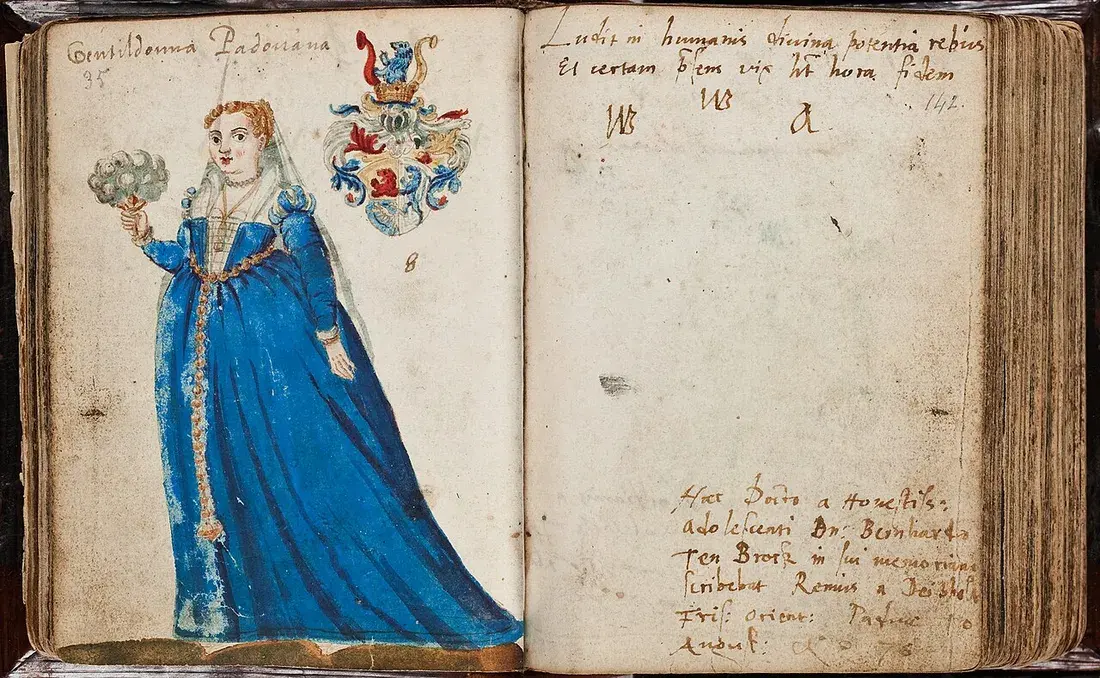
A 16th-century album amicorum folio with miniature watercolor portrait, family crest, Latin mottos, and handwritten inscription (Koninklijke Bibliotheek). - 1660s
The personal tradition grows
Friendship books become richer records of a person's intellectual and social world, filled with signatures, poems, drawings, and contributions from friends, professors, artists, and other people worth remembering.
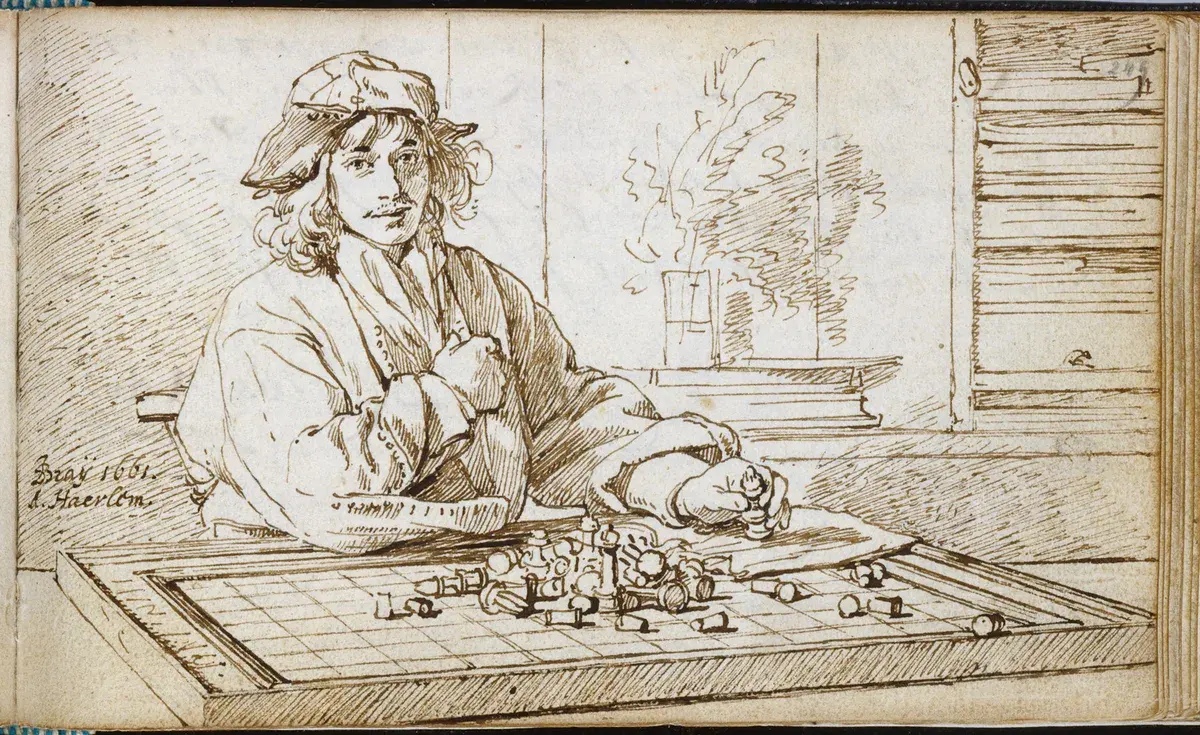
A 1661 ink drawing of a chess player by Jan de Bray, drawn directly in the album amicorum of Jacob Heyblocq (Koninklijke Bibliotheek). - 1700s
Still a book of people
The tradition remains personal. Students and scholars continue carrying albums and collecting contributions from the people they meet during their studies and travels.
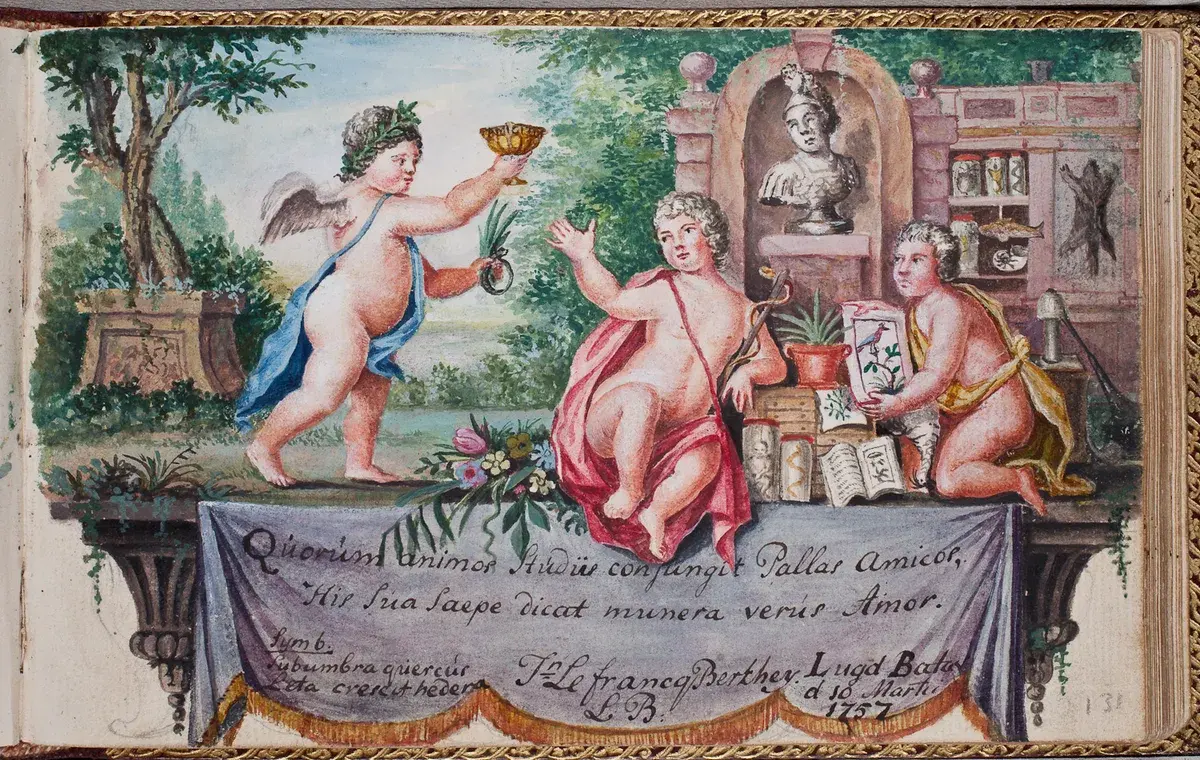
A 1757 watercolor dedication celebrating friendship in study, created in Egbert Philip van Visvliet's Leiden album (Koninklijke Bibliotheek). - 1806
Profiles at Yale College
Early American college class publication featuring printed silhouettes of students before photography existed.
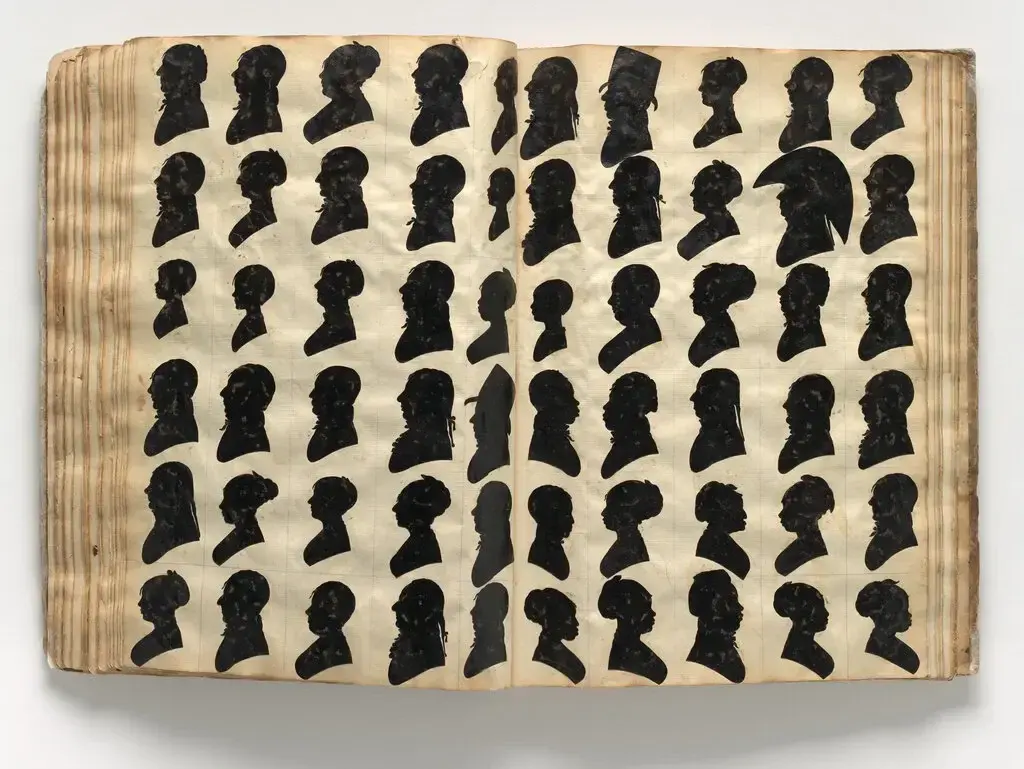
An example of a bound silhouette portrait album from around 1800, illustrating the portrait format used before photography (Smithsonian National Portrait Gallery). - 1845
The Evergreen (Waterville Academy)
Often cited as one of the earliest American secondary school annuals.
- 19th century
Photography shapes the annual
Photography and improved printing begin turning class books and annuals into rich photographic records of their communities.
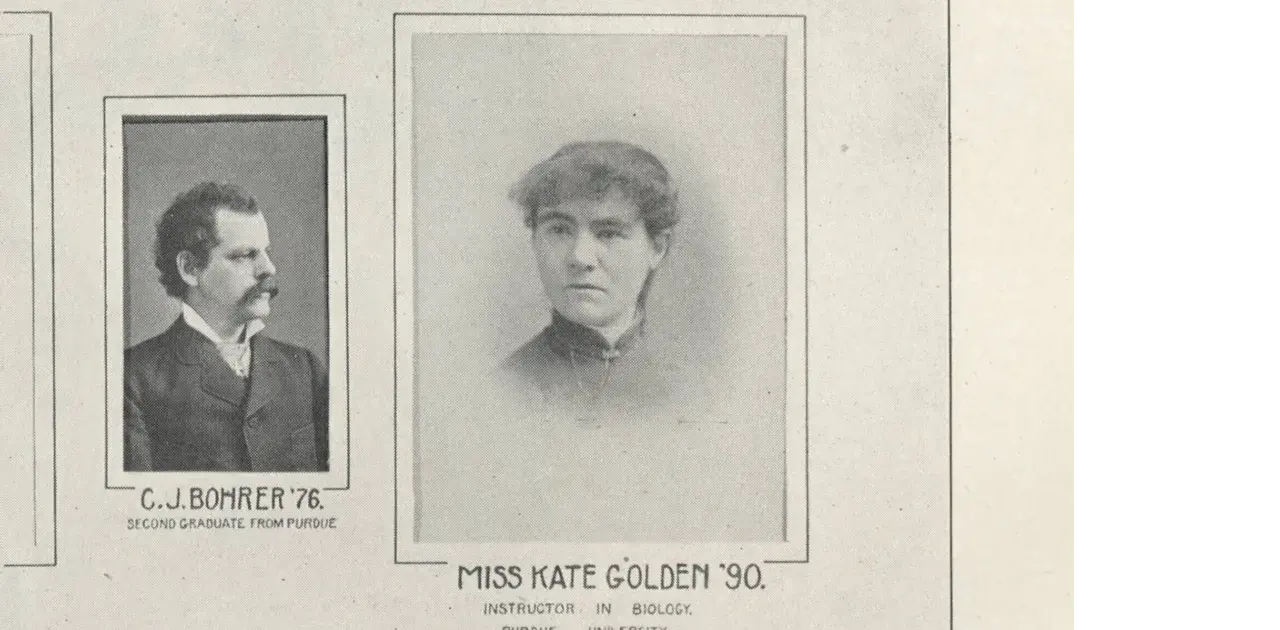
Photographic portraits begin appearing in university annuals (1895 Débris, Purdue University Archives). - 20th century
The institutional yearbook era
Committees, faculty advisors, and distribution days turn the tradition into an annual school ritual.
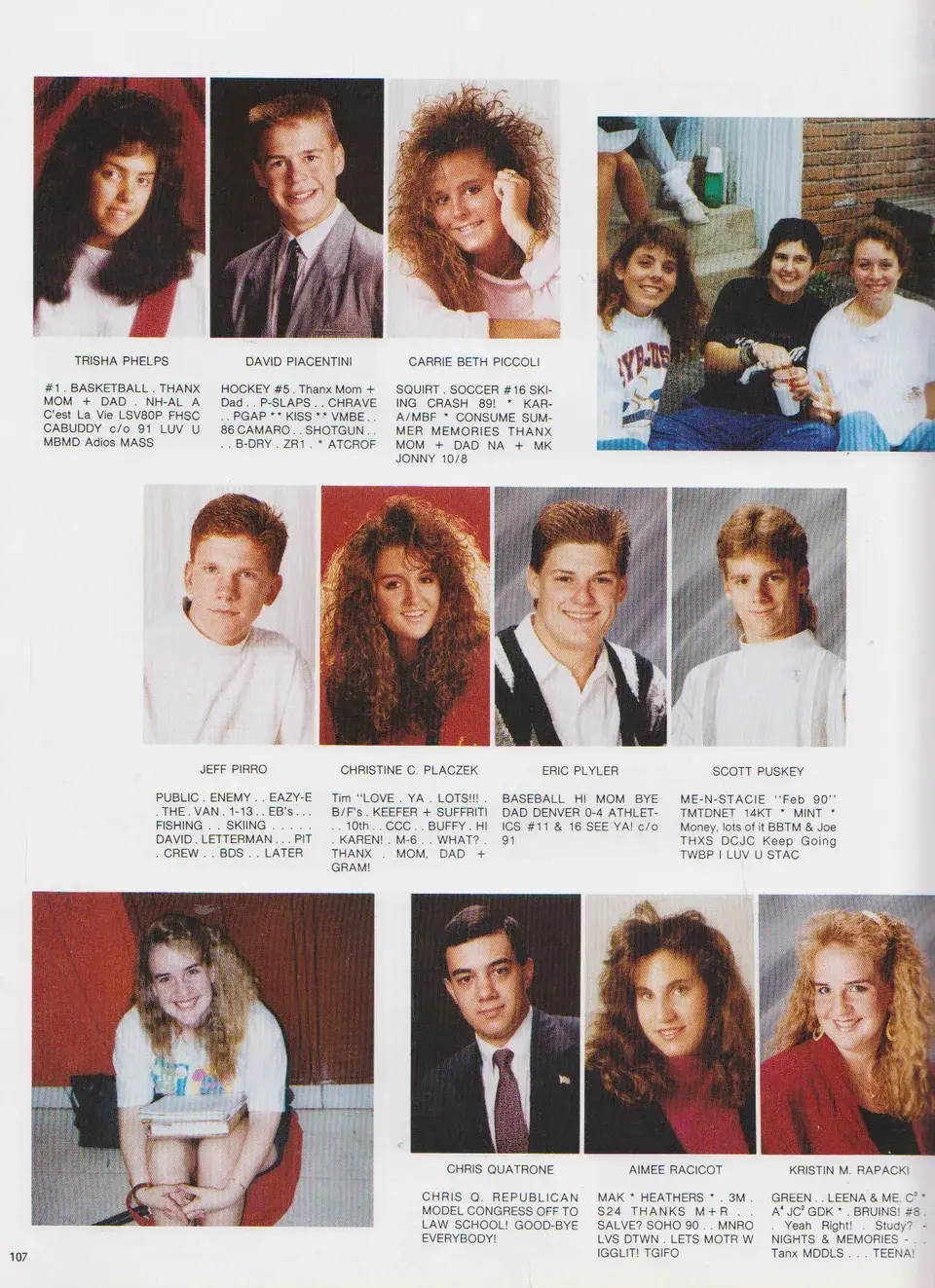
The institutional school annual at its peak: full-color senior portraits, student quotes, and campus snapshots (1991 Agawam High School annual). - Today
We can preserve almost everything
Photos, videos, messages, voice notes, and social posts let us record more of our lives than ever. But in that abundance, something has changed: we no longer decide what is worth preserving.

Thousands of moments captured across apps and devices, but no single physical artifact to bring them together. - yeerbook
The personal yearbook
Preserving the people and moments that matter to you.

Returning the yearbook to its origins: a physical book with limited space, where you intentionally choose the people, words, and moments that mattered during a period of your life, and invite the people who were part of it to leave something of their own.
Today, we can preserve almost everything
We have more ways than ever to record our lives. Photos, videos, messages, voice notes, and social posts can capture almost every moment.
But something was lost in that abundance: the act of choosing what is worth remembering.
A physical yearbook had limits. There were only so many pages, photographs, and messages it could hold. Someone had to decide what belonged. The same was true of the friendship books that came before it. You carried a book with limited space, and you chose the people and words worth putting inside.
Digital memory works differently. We can save almost everything. Thousands of photos sit in camera rolls. Messages get buried in group chats. Voice notes, screenshots, posts, and videos accumulate across apps and devices, often lost in what becomes a camera roll graveyard.
We became better at keeping memories, but perhaps worse at curating them.
A yearbook never tried to preserve everything that happened. It tried to preserve the people and moments worth remembering.
And maybe that constraint was part of what made it meaningful.
So why do we still keep old yearbooks?
Open an old yearbook decades after graduation and something interesting happens.
You start looking for faces.
You remember people you haven't thought about in years. You notice old hairstyles, forgotten friendships, inside jokes, handwritten messages, teachers, places, and moments that had seemed ordinary at the time.
A yearbook turns an abstract block of time into a permanent physical object. It doesn't contain everything that happened. It contains the things someone decided were worth carrying forward.
It gives a chapter of life a beginning, an ending, and a place to live.
This is part of why people keep yearbooks long after they have left school. The value isn't really in the paper or the portraits themselves. It's in the people and memories attached to them.
The book becomes a physical container for a period of life that would otherwise exist only in memory.
The yearbook was never just about school
Schools provided the ideal environment to create a shared book at scale. When hundreds of people share the same building, the same calendar, the same cohort, and a clear beginning and end, a standardized annual is both natural and efficient.
The school provided the printed shell: the portrait grids, the sports teams, and the official record. But the most personal part was always what happened on the final days: friends passing books back and forth to leave handwritten notes, inside jokes, and signatures in the margins.
School yearbooks served that chapter of life well. But as we grow older, our lives no longer move in lockstep with a graduating class.
Our chapters become uniquely our own: a year living abroad, a group of friends who traveled together, the early years of a relationship, a startup built with a small team, a year of raising a child, a sabbatical, or a community formed around a shared season.
Without an institution to organize a book for us, we default to digital abundance. We take thousands of photos across phones and devices, letting them scatter across cloud storage and camera rolls where nothing feels deliberately chosen.
They may not end with a graduation ceremony, but our unique adult chapters still deserve a physical record of their own, and the people who shared those chapters with us still have something worth saying.
Taking the yearbook back to its roots
This is where yeerbook comes in.
yeerbook isn't an attempt to make adult life look like high school. It takes the yearbook beyond school by returning to the idea that came before the school yearbook: a personal yearbook for preserving the people, words, experiences, and memories that mattered during a period of your life.
That begins with your own year: the quiet mornings, the unglamorous milestones, your own voice notes, and the photos and reflections that might mean something only to you. You do not need a committee or a large crowd to have a chapter worth keeping.
And just like the historical friendship books that traveled with their owners, you can invite the specific people who shaped each chapter to leave something of their own behind: a handwritten signature or drawing, a personal note, a photo sticker, or a voice memo.
The result is not simply a photo album or a list of contacts. It is a record of a period of your life, shaped by your own experiences and by the people who were there.
It is taking it back to where it began.
The technology is different. The reason for making the book is not.
Bringing back the "yeer"
The name brings two ideas together.
The first is historical. "Yeer" is an old spelling of "year," found in Middle English texts and in the works of Chaucer, centuries before English spelling was standardized. It is a small connection to a time when words, books, and the ways we preserved memories looked very different from today.
The second is social: year + peer. A personal yearbook is not really just about a calendar year. It is about the people who shared that year with you: the friends, family, and companions who were there, and the words, photos, and memories they leave behind.
So the name "yeerbook" brings both together: a quiet nod to the past and an enduring tradition, and to the peers who shared that chapter with you.
The next chapter of the yearbook
The history of the yearbook tells a different story from the one we usually imagine.
It did not begin with schools. It began with people.
People who traveled, met others, formed relationships, experienced new chapters of life, and chose to preserve some trace of what mattered.
Schools eventually gave that tradition a structure and turned it into an annual institution. Photography made it visual. Digital technology made preservation limitless.
The format changed. The underlying desire did not: to remember the people who were there, and to turn a chapter of life into something you can return to.
But in our modern abundance, we lost what made the yearbook powerful in the first place. The meaning was never in saving everything. It was in the discipline of choosing the few.
The next chapter of the yearbook is not going back to the past, but returning to what made it meaningful in the first place: intentionally choosing the people and memories that matter, and preserving them in a physical artifact you can hold in your hands.
The year you lived. Bound and signed.
Frequently asked questions
What were alba amicorum?
Alba amicorum, Latin for "books of friends," were personal books that became popular in 16th-century Europe, particularly among students and scholars. People used them to collect signatures, poems, quotations, drawings, personal mottos, and reflections. They belonged to a broader tradition of personal memory-keeping, showing that the impulse to create a physical record of one's own life and relationships existed long before institutional school yearbooks.
Does a personal yearbook have to be signed by friends?
Not at all. While having friends, partners, or family sign pages adds a wonderful layer of warmth, a personal yearbook begins with your own journey: your photos, voice notes, quiet milestones, and private reflections. Like the commonplace books of earlier centuries, it is first and foremost a book for you, documenting what mattered to your own life.
What was the first school yearbook?
One of the earliest examples of a college yearbook is Yale's Profiles of Part of the Class Graduated at Yale College, published in 1806. The Evergreen, published by Waterville Academy in New York in 1845, is often cited as one of the earliest American secondary school yearbooks, though archival records from the period vary.
Why did yearbooks become associated with schools?
Schools provided an unusually convenient structure for creating a shared memory book. They brought together a defined group of people, followed a common calendar, and had a clear beginning and ending to each academic year. That made schools a natural environment for the tradition to grow. But the underlying idea was never exclusive to schools.
Why would adults want a yearbook?
Because adults still have meaningful chapters of life. The people you met during a year abroad, the friends you traveled with, the team you built a company with, or the community that formed around a particular period of your life can be just as important as the people you knew in school. The difference is that adulthood rarely provides an institution that automatically creates the book for you.
How does yeerbook work?
You create your yearbook from the photos, words, and memories you want to preserve. You can also invite other people to contribute through private links, so friends, partners, family members, travel companions, or collaborators can add their own handwritten signatures, drawings, notes, photo stickers, or voice memos without needing an account or downloading an app. At the end, the memories become a physical hardcover book you can keep.
Why is yeerbook spelled with two e's?
"Yeer" is an authentic historical spelling of "year" found in Middle English texts and in the works of Chaucer, centuries before English spelling was standardized. It also reflects "year" plus "peer": a meaningful year is shaped by the people who share it with you. The name brings both together: a quiet nod to the past and an enduring tradition, and to the peers who shared that chapter with you.
Sources
- Gelders Archief (Arnhem, Netherlands). Archief Van Rhemen, Ms. 134: Album amicorum of Stephanus van Rhemen (Wittenberg, 1556).
- Royal Library of the Netherlands (Koninklijke Bibliotheek, The Hague). Alba amicorum / Vriendenboeken collection: 16th- to 18th-century albums and provenance records.
- University of Groningen Library. Alba Amicorum: Social media before the term was coined (exploring interpersonal networks in early modern academic culture).
- Yale University Library Manuscripts and Archives. Profiles of Part of the Class Graduated at Yale College (1806).
- Waterville Academy Archives. The Evergreen: Secondary School Annual (Waterville, New York, 1845).
- Purdue University Archives. The Débris: Class Annual of Purdue University (1895).
- Middle English Dictionary. University of Michigan. Etymological entries for "yeer" and "yere" in 14th-century Middle English literature.
- Petrelli, D., van den Hoven, E., & Whittaker, S. (2009). Making History: Intentional Capture of Future Mementos. CHI Conference on Human Factors in Computing Systems, 2723-2732.
Related reading
Your year, signed by the people who were in it.
No classroom or committee required. Just a year worth remembering, and the people who made it meaningful.
Free to add your first memory. No credit card required.
Or gift a yeerbook